

✍️ By the ChimelongOceanKingdom.com Team — Zhuhai theme-park writers and repeat visitors · 🗓️ Last updated: November 2026 · ⏱️ ~12 min read
Ask us what separates Reino del océano de Chimelong from a very good aquarium with rides bolted on, and the honest answer is the show schedule. Three big animal theatres, a stunt show on the lagoon, up to three parades a day and one of the best fireworks productions in Asia all share a single lakefront stage set. On a well-planned day the shows are the skeleton that everything else hangs on; on a badly planned day you will walk four kilometres chasing start times and still miss the finale. This guide exists so your day is the first kind.
One caveat before the detail, and it matters: times shift with the season, the weather and crowd levels. The schedules below are recent typical patterns that have held across several of our visits, not a contract — verify everything on the official app or the boards outside each theatre when you arrive. If you are building your first visit from scratch, our ultimate guide covers the whole park, and the one-day itinerary turns the schedule below into an hour-by-hour plan, while the main Chimelong Ocean Kingdom hub keeps tickets and hours current.
🗓️ How the Daily Schedule Works
Each animal theatre runs two to four performances a day, clustered in a late-morning, mid-afternoon and early-evening rhythm. On recent typical schedules the Teatro Dolphin runs at 12:00, 15:30 and 17:00, the Teatro Beluga at 11:00, 14:00 and 17:45, and the Teatro Sea Lion at 13:00, 14:00 and 18:00. In the summer months the park can stay open to around 21:00 and the schedule stretches with it; in quieter seasons the last shows pull earlier, because the whole day is built backwards from the roughly 20:00 finale over Hengqin Sea.
Verify on arrival, every time. The official app and mini-program list the day’s times, each stadium posts a board, and staff announce changes — a typhoon-adjacent afternoon in September once reshuffled half the schedule on us with an hour’s notice. Photograph the board at the entrance as you pass, and treat any printed list, including ours, as a starting hypothesis rather than gospel. Every show below is included in standard admission; nothing on this list needs a separate ticket.
| Show | Where | Recent typical times | Best seats |
|---|---|---|---|
| Teatro Dolphin | Dolphin Bay, shaded stadium | 12:00 / 15:30 / 17:00 | Centre rows, about a third of the way up |
| Teatro Beluga | Polar Adventure, shaded stadium | 11:00 / 14:00 / 17:45 | Centre sections one tier above the pool |
| Teatro Sea Lion | Mt. Walrus, shaded stadium | 13:00 / 14:00 / 18:00 | Front half, for the comedy bits |
| Flybord Espectacular | Lagoon stage on Hengqin Sea | Afternoon slots — check boards | Lakeside rail within sight of the stage |
| Desfile del océano de Chimelong | Route around Hengqin Sea | Daytime — check boards | Any curb with shade, claimed 15–20 min early |
| Symphony of the Ocean | Hengqin Sea lakefront | ≈ 20:00 finale, weather permitting | West-bank rail or lakeside steps, 30–45 min early |
The dolphin stadium is the biggest of the three animal theatres and the production most visitors mean when they say “the show”. It is where most families start, and the times tend to anchor the middle of the day. If you watch only one animal show, this is the default choice.

One more principle before the theatre-by-theatre detail: everything above is daytime material, and the whole schedule bends toward the evening. The Symphony of the Ocean finale — fountains, flame, drones and fireworks over Hengqin Sea — closes the day around 20:00 in most seasons, and the last animal shows are timed so you can catch one and still claim a lakeside spot afterwards. We cover the finale strategy in full further down.

🐬 Dolphin, Beluga or Sea Lion: Comparing the Three Theatres
Before comparing the productions, one piece of leverage most visitors ignore: show times are the best queue-secret in the park. When the 14:00 beluga show pulls a few thousand people into a stadium, the rides in Polar Adventure empty out; when the sea lion comedy plays at 13:00, Mt. Walrus’s water rides go walk-on for forty minutes. We plan rides against show times deliberately, and it is the difference between a 60-minute wait for Polar Explorer and a 10-minute one. The rides guide ranks what to run for when the lines collapse.
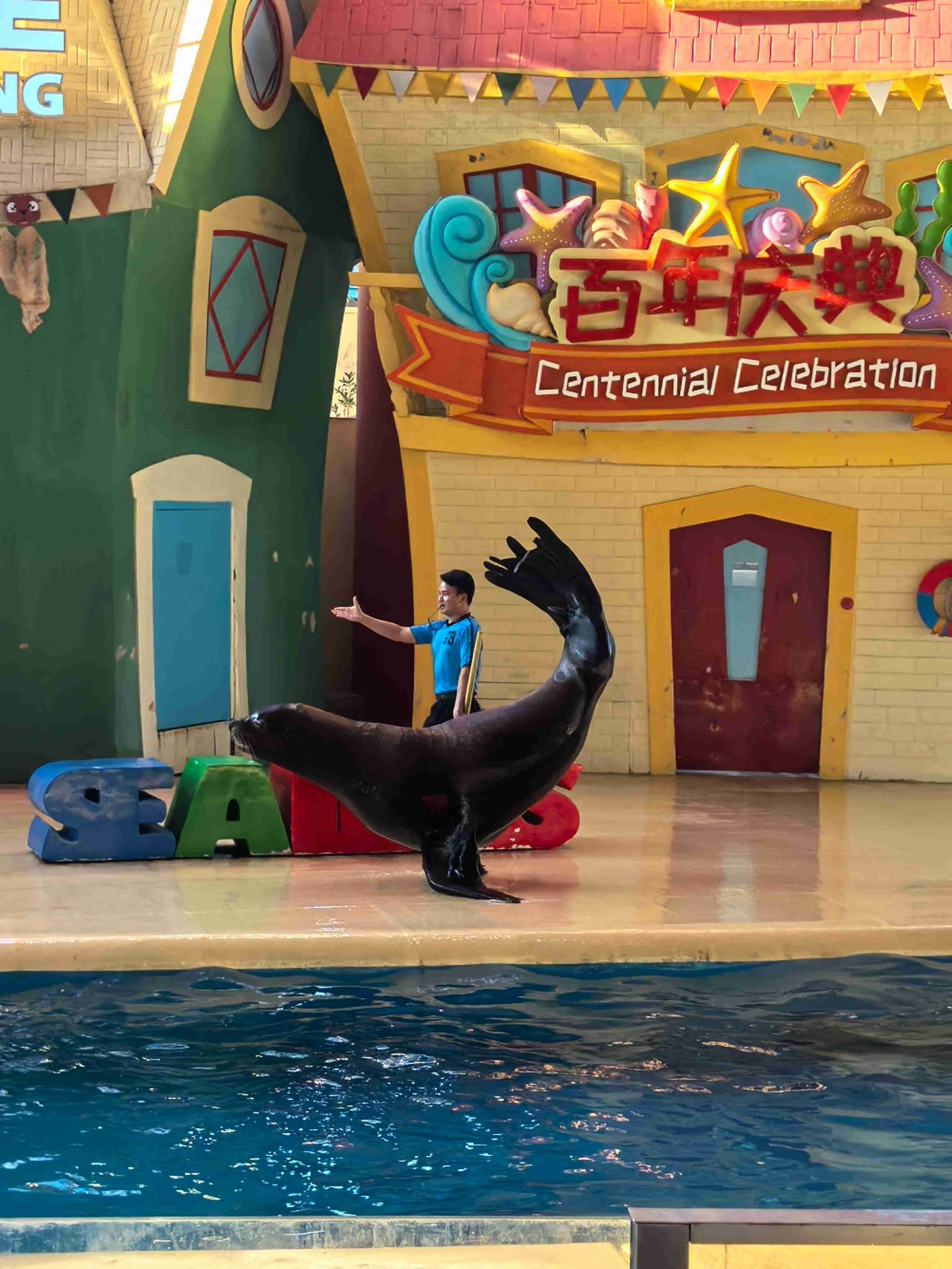
The three animal theatres have distinct personalities. The Teatro Dolphin is the big, polished spectacle — large cast, choreographed set pieces, the show most likely to make a first-time visitor gasp. The Teatro Beluga is the elegant one: slower, music-driven, with the strange beauty of white whales against deep blue water. The Teatro Sea Lion is the comedy hour, and the target audience of sotto-voce sea-lion sass is unmistakably the under-tens, who scream with laughter at every bit. All three play in big shaded stadiums, which makes them as much climate strategy as entertainment in the Zhuhai heat.
If you can only fit one, take the dolphin show for spectacle or the sea lion show if your crew is young and easily delighted — the beluga show is wonderful but it lands best when you have just come from the polar halls, as we suggest in our Polar Adventure guide. On seats: the middle of the stand, a third of the way up, gives you the full-stadium view that front rows trade away; front rows buy proximity and spray, and children usually consider that a bargain. Shows repeat through the day, so there is no need to camp — arrive fifteen to twenty minutes early, sit down, and relax. Our per-venue guides cover the Teatro Dolphin, el Teatro Sea Lion and the Teatro Beluga in detail.
The sea lion arena earns a special family mention: the front half of the stand sits close enough for children to catch every expression, the comedy plays to the youngest crowd in the park, and the deep shade makes the 13:00 or 14:00 show the best-value rest stop on the Mt. Walrus side of the lake. Aim for the covered rows if the forecast looks grey. The show runs through most weather short of a proper storm.
✈️ Flybord Spectacular: Human Flight on the Lagoon
Between the animal shows, the lagoon stage hosts the Flybord Espectacular, where athletes on flyboards — water-jet boots fed by jetskis — climb, spin and backflip twenty feet above the lake. It is short, loud and relentlessly photogenic, and because it happens outdoors in the middle of the park you will often catch it by accident. Do not rely on accident: check the board for the afternoon slot, then position yourself on the lakefront with the stage in view rather than behind a tree.
The honest assessment: Flybord is the lightest-weight production on this list, and that is exactly its role. It fills the late-afternoon gap between the last animal show and the parades, it needs no language to enjoy, and it is one of the few shows where the lakeside rail genuinely is the best seat. Our Flybord Spectacular guide covers the act in detail.
Photographers should treat it as the practice round for the finale: the same lake, the same light direction, athletes instead of fireworks, and a fraction of the crowd. Shoot in burst mode against the water, expose for the spray rather than the athlete, and you will come away with the single most dramatic action set of the day. Then put the phone down for the last two minutes and just watch — the backflip sequences earn it.
🎊 The Parades: Daylight Colour and the Night Glow
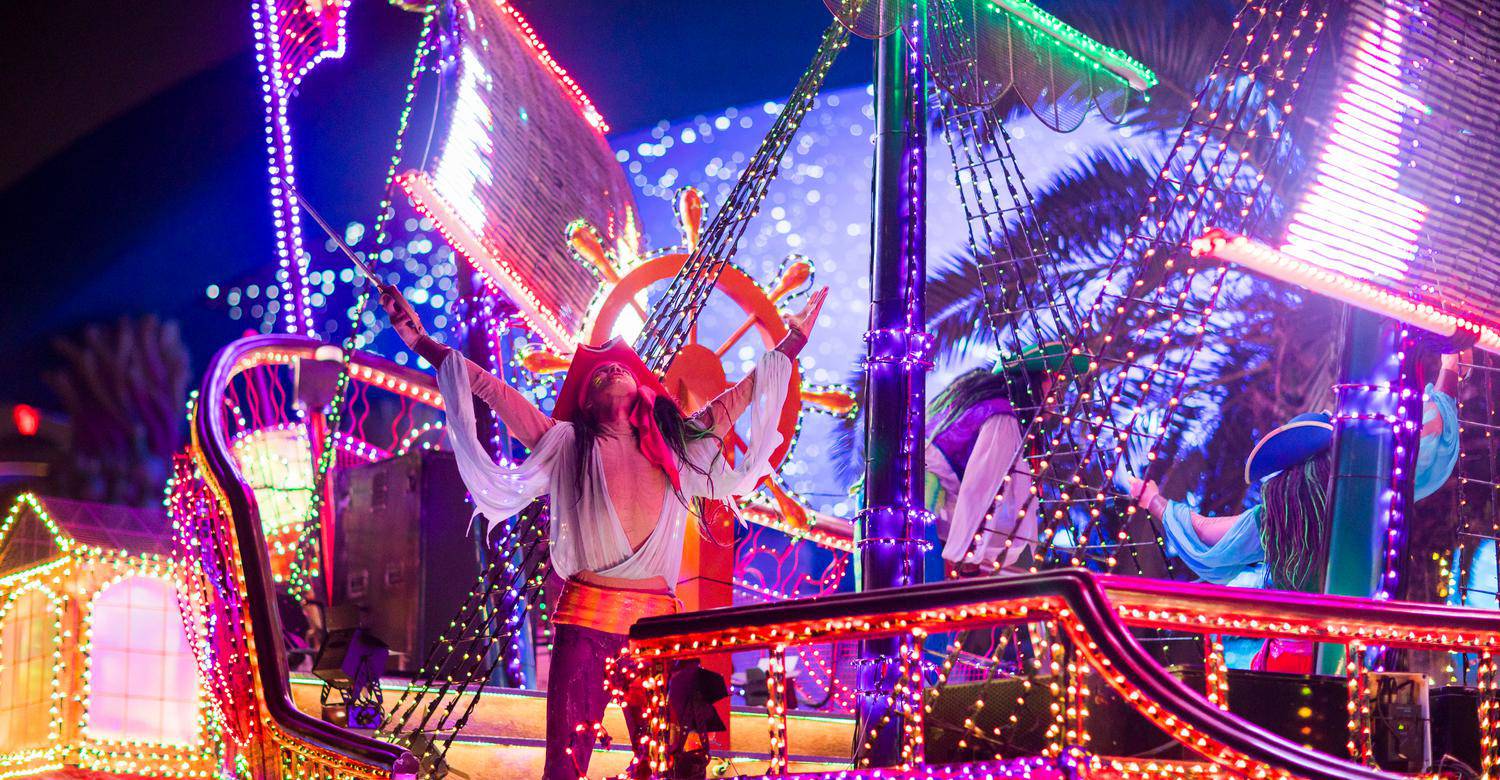
Three parades share the route around Hengqin Sea. The daytime Desfile del océano de Chimelong is the family classic — marine-themed floats, dancers and the park’s characters working the crowd. After dark, the Desfile del Viaje de las Luces del Reino del Océano floats the same route as a river of illuminated sculptures; it won a Thea Award from the Themed Entertainment Association, and it is, in our opinion, the best free thing in the park. The Desfile de Súper Mamuts adds prehistoric-scale beasts to the mix — enormous, slightly absurd and adored by children.
Viewing is easy but not effortless. Claim a curb fifteen to twenty minutes ahead on normal days, on the shaded side if the parade runs at midday, and accept that the character performers will wave at your children and not at you. The night parade is the natural appetiser for the fireworks: it drifts around the lake as the sky darkens, and when the last float passes, the crowd simply turns toward the water and waits. Our guides to the Desfile del océano de Chimelong, el Journey of Lights Parade and the Desfile de Súper Mamuts cover each in turn.

🎆 Symphony of the Ocean: Planning for the 8 pm Finale
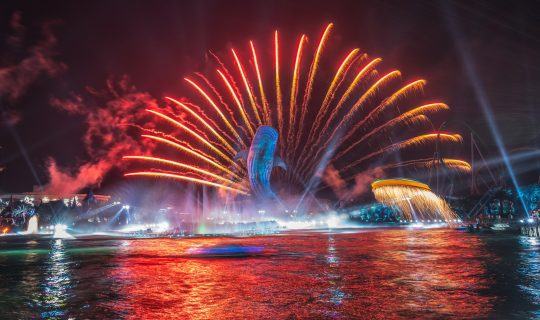
The Symphony of the Ocean is the reason thousands of people stay to the end. Staged over Hengqin Sea, typically around 20:00, it stacks fountain screens, flame jets, a drone show and the park’s signature “Blue Miracle” fireworks — a production that has won an IAAPA Brass Ring — into roughly twenty minutes of escalating spectacle. The lake is enormous, which is good news: unlike at smaller parks, you do not need a magic spot, you need a reasonable spot claimed at a reasonable time.
Our strategy after several finales: arrive thirty to forty-five minutes early on ordinary days, a full hour during holidays and summer weekends. The rail along the west bank of the lake and the lakeside steps opposite the show stage are our default claims — rail for the photos, steps if you have children who will want to sit down. Stake your patch after the last afternoon show rather than drifting over at 19:50, eat nearby, and treat the wait as part of the evening. If the crowd pressure is too much, one block back from the rail still gives a full view over people’s heads; the trade-off is that the fountain detail gets lost, and the fountains are half the show. After the finale, exits surge — either move in the last thirty seconds or linger ten minutes and let the wave pass.
💡 Tip: claim your finale spot in two shifts — one adult camps the rail after the last afternoon show while the other takes the kids on a final ride, then swap in for dinner. Nobody enjoys an hour on a rail with a tired four-year-old.
📱 Checking Times, Choosing Seats, Escaping the Heat
Three tools cover schedule-checking: the official app or mini-program for the day’s full listing, the printed boards outside each stadium, and staff, who will tell you honestly if a show has moved. Weather reshuffles happen — high wind grounds the drones, heavy rain shortens outdoor acts — so re-check after lunch on any grey day. And remember the seasonal shape of the day: in summer the whole schedule stretches toward a 21:00 close, while in cooler months the finale still lands near 20:00 but the afternoon shows pull earlier. Our best-time-to-visit guide maps the seasons.
Seat strategy in one paragraph: in the three animal theatres, go centre and mid-height for the full picture, front if your kids want to be part of the action; at Flybord and the parades, the lakefront rail wins; at the finale, anywhere you can stand still for twenty minutes with a view of water. One more underrated use of the theatres: they are shaded, seated and long enough to be a real rest. Families who treat each show as a scheduled sit-down break consistently report better afternoons than the sprinters.
🎯 A One-Day Show Strategy
The way to fit the best shows into one day is to pair each with its nearest zone, so the walking always has a purpose. Start the morning in Polar Adventure and take the 11:00 beluga show as its centrepiece. Drift to Dolphin Bay for lunch and the 12:00 or 15:30 dolphin show depending on your pace. Slide one block to the Whale Shark Aquarium in the gap — our aquarium guide explains why the light is best mid-morning anyway — then cross to Mt. Walrus for the 13:00 or 14:00 sea lion show and a water ride, because you are already soaked-adjacent. Late afternoon belongs to the lake: Flybord, the night parade, dinner, and the finale.
Be realistic about the cap. Two animal shows plus the parades and the finale is a full, satisfying day for most families; three animal shows plus everything else is a march, and children will bill you for it later. If you hold a two-day ticket, split the schedule: theatres and the aquarium on day one, rides and repeats on day two — our rides guide explains what deserves a second visit. And if you are building the whole day around the schedule rather than the other way round, the hour-by-hour version lives in our one-day itinerary.
💡 Tip: pick your two unmissable shows the night before, treat everything else as a bonus, and build ride and meal plans around only those two anchors. A loose show plan beats a jammed one every single time.
❓ Frequently Asked Questions
Are the shows included in the ticket price?
Yes — all three animal theatres, the Flybord Spectacular, every parade and the Symphony of the Ocean finale are included in standard one-day admission, with no reserved seating or show tickets to buy. What costs extra are the up-close animal encounters such as the beluga meet-and-greet and the manatee feeding sessions, plus food, lockers and merchandise. If a staff member ever offers you a paid show seat, it is a premium package, not a requirement to see the show.
What are the best seats at the animal theatres?
In all three stadiums the sweet spot is centred, roughly a third of the way up, where you see the whole stage and the water work at once. Front rows trade the full picture for proximity, spray and the chance of being picked for audience segments — brilliant with kids, less fun if you are camera-shy. Arrive fifteen to twenty minutes early for a free pick of either; the stadiums are large and nobody is turned away in normal conditions.
How many times a day does each show run?
On recent typical schedules, each of the three theatres runs three performances a day. The Dolphin Theatre plays at 12:00, 15:30 and 17:00, the Beluga Theatre at 11:00, 14:00 and 17:45, and the Sea Lion Theatre at 13:00, 14:00 and 18:00. Parades and the Flybord slots vary more, and everything shifts with season, weather and holidays, so confirm the day’s times on the official app or the boards at each venue when you arrive.
Is the fireworks show every night?
The Symphony of the Ocean is the park’s standard nightly finale, usually around 20:00 over Hengqin Sea, and it runs on most normal operating days. Strong wind, heavy rain and typhoon-adjacent weather can shorten it, drop individual elements such as the drones, or cancel it entirely, and park hours themselves stretch later in summer. Check the app or park boards on the day — and if the finale matters to your trip, do not plan your only visit on a day with a storm forecast.
How early should we claim a fireworks spot?
Thirty to forty-five minutes before the show is the standard window on ordinary days, and the prime west-bank rail fills first. During holidays, summer weekends and any night with a special event, treat an hour as the realistic minimum. With children, choose a spot a few rows back with an escape route behind you rather than a locked-in rail position — a slightly worse view with a quick exit beats a perfect view with a forty-minute crowd crush afterwards.


